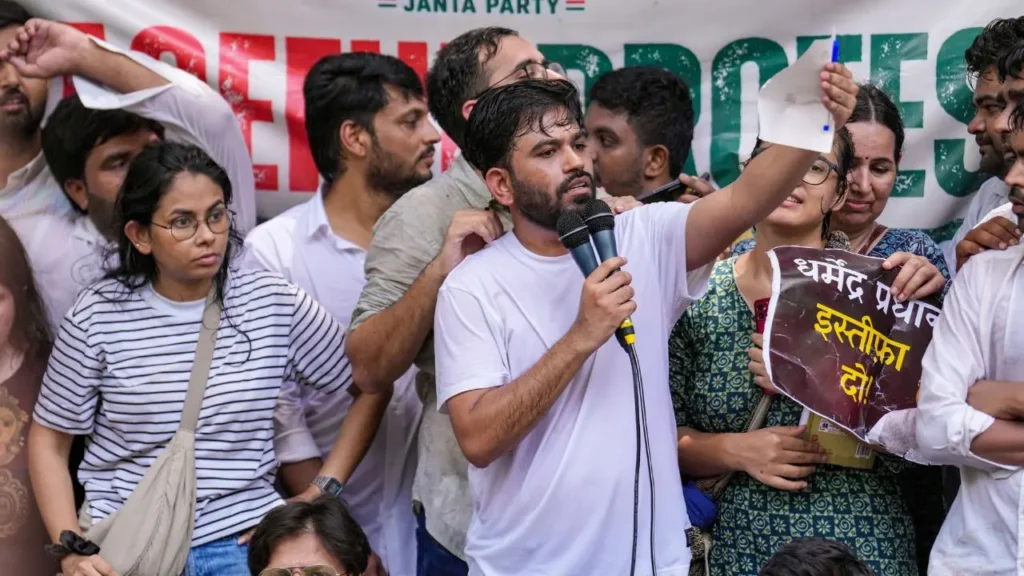

New Delhi/Mumbai: Protests were held in Mumbai and New Delhi on Friday, October 2, over demands concerning Chief Election Commissioner (CEC) Gyanesh Kumar and the Election Commission’s handling of electoral-roll revision. The demonstrations were organised separately by the Cockroach Janata Party (CJP), political parties, student organisations and civil-society groups.
CJP founder Abhijeet Dipke led the organisation’s campaign in Mumbai, where the group had announced a protest at Shivaji Park. In Delhi, separate groups and opposition-linked organisations gathered around Jantar Mantar despite police restrictions. The demonstrations centre on allegations and concerns about the Special Intensive Revision (SIR) of electoral rolls and the functioning of the Election Commission.
What happened in Mumbai?
CJP had announced a ‘Jail Bharo Andolan’ in Mumbai for Gandhi Jayanti after Mumbai Police denied permission for its proposed Shivaji Park gathering. Dipke had said the organisation would proceed with its protest despite the permission dispute.
Reports on Friday said the CJP demonstration went ahead in the Shivaji Park area. The group has demanded Kumar’s resignation and has also called for changes to the electoral-roll revision process and greater transparency in the appointment of the Chief Election Commissioner.
Before the protest, Dipke was reported to have been taken to a police station after being seen with supporters carrying placards at Marine Drive. Reports differed on whether the episode should be described as a detention, while CJP representatives said he was not detained. RumorRush is therefore not treating a detention as an established fact.
Separate protests in Delhi
In New Delhi, AAP leaders, Left-linked groups, student organisations and civil-society activists were among those involved in demonstrations related to the Election Commission and electoral-roll revision. Delhi Police had denied permission for a proposed gathering at Jantar Mantar and increased security in central Delhi.
The Indian Express reported that more than 500 protesters were detained during the Delhi demonstrations, including AAP leaders and student activists. Separately, authorities restricted access at 11 Delhi Metro stations around central Delhi as part of the security arrangements. These measures affected areas around Jantar Mantar, Connaught Place, Parliament Street and nearby locations.
What are the protesters demanding?
CJP has called for the resignation of CEC Gyanesh Kumar. The organisation has also demanded action concerning the SIR electoral-roll exercise, including a freeze of the 2025 electoral roll and greater transparency in the process for appointing the Chief Election Commissioner.
Other political parties and civil-society groups have raised their own concerns about the Election Commission and the electoral-roll revision process. These demands and allegations are positions of the organisations involved and should not be treated as established findings.
What does the Election Commission say?
The Election Commission has rejected the interpretation that internal disagreements amount to a breakdown in the Commission’s decision-making. In a September 23 statement, the Commission said that written observations and differing views are part of normal deliberations in a multi-member constitutional body and that decisions, including those concerning SIR, were taken through the Commission’s established process.
In a later statement covering its September 26 meeting, the Commission said the SIR exercise had been approved unanimously and announced measures including a review of the ECINET system, additional assistance for voters facing difficulties during the process, and extensions to claims and objections deadlines in Delhi and Maharashtra.
Why is SIR at the centre of the dispute?
The Special Intensive Revision is an electoral-roll verification exercise intended to update voter lists and identify duplicate, ineligible or otherwise problematic entries. The Election Commission says safeguards are built into the process, including opportunities to file claims and objections and mechanisms for inclusion of eligible voters whose names may be missing.
Critics and protest organisers have raised concerns about how voter names are being added, removed or verified and about the transparency of the Election Commission’s internal decision-making. The claims about irregularities remain contested, and the Election Commission has publicly disputed several of the interpretations surrounding the process.
What happens next?
CJP has announced plans for further demonstrations in other cities before a larger gathering in Delhi later in October. Opposition parties and student groups are also planning or conducting separate actions concerning the Election Commission and electoral-roll issues.
The protests come amid continuing public and political scrutiny of the SIR exercise and the Election Commission’s functioning. The situation remains developing, and details may change as authorities, political organisations and the Commission issue further statements.
Sources and further reading
- The Hindu: CEC Gyanesh Kumar row and October 2 protest live updates
- Reuters: CJP and student groups protest over demand for poll chief’s resignation
- The Indian Express: Protests in Mumbai and Delhi
- The Indian Express: Delhi Metro restrictions ahead of protest
- Press Information Bureau: Election Commission decisions on SIR and electoral-roll processes
- Press Information Bureau: ECI statement on unanimous decisions and internal deliberations
Last updated: October 2, 2026.