
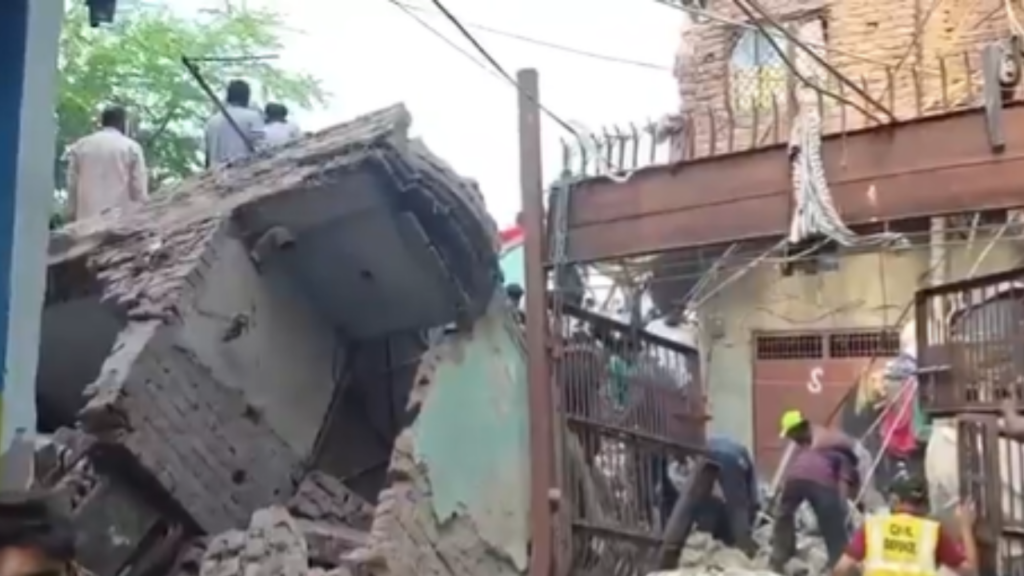

Three people, including a pregnant woman and children, were killed and eight others were injured after a residential building collapsed in northeast Delhi’s Seemapuri on Wednesday. The collapse near Idgah Machhli Mandi triggered a large rescue operation involving the Delhi Fire Service, Delhi Police, NDRF, DDMA, MCD and DUSIB, with local residents also helping pull people from the rubble.
The incident initially came to light as a building collapse with several people feared trapped. By Wednesday evening, authorities said 11 people had been rescued, eight of whom were taken to Rajiv Gandhi Super Speciality Hospital in Tahirpur. The deaths included a girl of about 12, 21-year-old Gulafsa, who was around four months pregnant, and another young child.
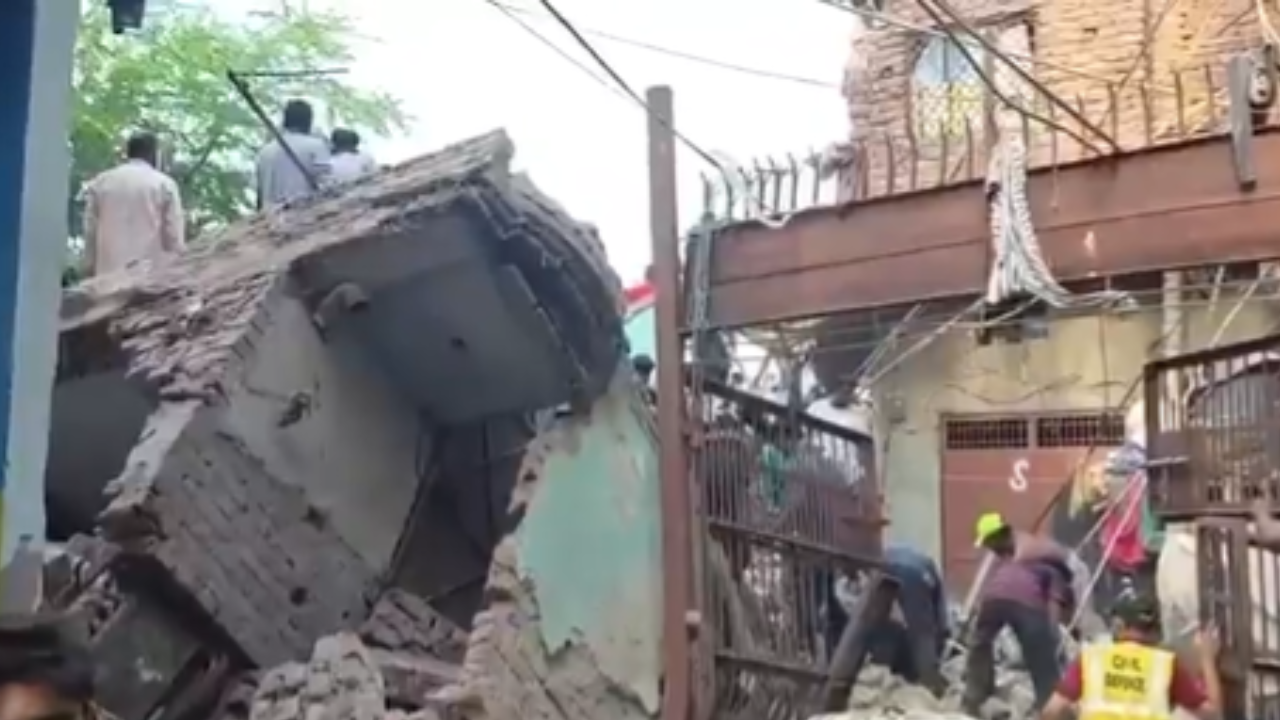
Image: Times of India, used from the image accompanying its Seemapuri building-collapse report.
A rescue operation that quickly became a race against time
The collapse was reported at around 3:30pm near Idgah Machhli Mandi in New Seemapuri. The structure came down onto adjoining areas, damaging portions of nearby buildings and a boundary wall, according to the Municipal Corporation of Delhi.
Emergency teams had to work through a dense pile of concrete, bricks and other debris. Heavy equipment was brought in to clear larger sections, while rescuers searched more carefully in areas where people might still be alive. Residents also joined the initial response, using their hands to move rubble and helping transport injured people to hospitals.
At one point, authorities suspected that two or three people could still be trapped beneath the debris. Residents told reporters they could hear people beneath the rubble, underscoring the difficulty of removing debris quickly without putting those trapped, or rescuers, at additional risk.
The building’s condition was already becoming a concern
The collapse has raised questions about the condition and history of the structure. Police said the building occupied a plot of roughly 225 square feet, while the MCD described it as a roughly 20-to-25-year-old structure in a densely populated settlement near Idgah Machhli Mandi.
According to the MCD, local enquiries indicated that cracks had appeared in the building after tremors associated with an earthquake in Uttarakhand on Tuesday evening. Neighbours also said the owner had been in the process of vacating the building. The civic body said the structure was occupied when it collapsed. citeturn0search3turn2search2
Those accounts are important, but they do not establish that the earthquake caused the collapse. Authorities have said the precise cause will have to be determined through an investigation. The distinction matters because cracks following tremors can be evidence of damage without proving that seismic activity was the decisive structural failure.
Why the earthquake theory is still only a theory
Residents reported that cracks became visible after the tremors, and that has led to speculation that the earthquake may have weakened the building before Wednesday’s collapse. But officials have not established a causal link.
That means the collapse should not yet be described as an earthquake-caused disaster. A technical assessment will need to determine whether the structure had pre-existing weaknesses, whether later alterations affected its stability, whether the tremors contributed to damage, or whether several factors combined.
The distinction is particularly important in Delhi’s older and densely built neighbourhoods, where structural safety can be affected by age, incremental construction, alterations, poor maintenance and limited access for emergency crews.
Seemapuri comes a month after another deadly Delhi collapse
The Seemapuri tragedy comes less than a month after a building collapse in southwest Delhi’s Satya Niketan that killed seven people and injured others. That incident triggered a separate investigation into renovation work and the structural changes made to the building.
The proximity of the two incidents has renewed attention on building safety in Delhi, particularly in areas where residential structures have evolved over many years and where emergency access can be difficult.
It would be premature, however, to assume that the two collapses had the same cause. The Seemapuri investigation will need to establish the structural history of the building and identify any specific failures or violations before responsibility can be assigned.
The questions that remain after the rescue operation
The immediate priority has been finding survivors and treating the injured. The next phase will be establishing why the structure failed and whether nearby buildings are safe.
That investigation will need to examine the building’s construction history, its condition before the collapse, any alterations or extensions, reports of cracks, the effect of Tuesday’s tremors and whether any warnings or notices existed before the incident.
For the families affected, the most urgent concerns are more immediate: locating missing relatives, obtaining medical treatment for survivors and understanding what support will be available after the rescue teams leave.
The Seemapuri collapse is therefore not only a story about a building falling down. It is also a reminder of the consequences when structural safety becomes difficult to verify in dense urban neighbourhoods. The final cause will matter because it will determine whether the tragedy points to an isolated failure or exposes a wider safety problem that authorities need to address.
Sources and further reading:

