
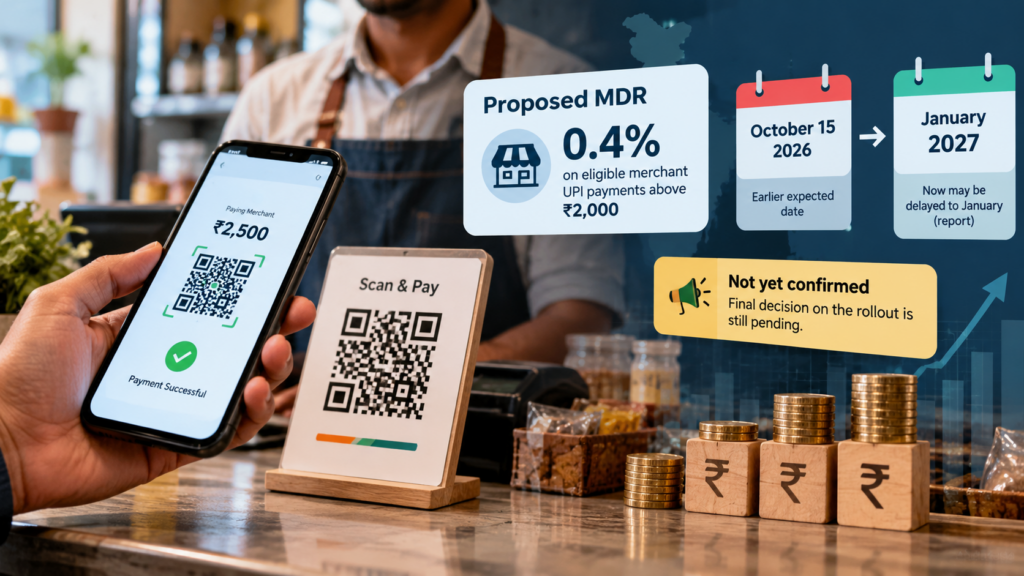

India’s proposed Merchant Discount Rate (MDR) on select UPI transactions above ₹2,000 may not begin on October 15 as originally planned. Reports on October 9 indicate that the rollout could be pushed to January 1, 2027, giving merchants and payment companies more time to prepare for the new fee framework.
The possible delay is still not final. The National Payments Corporation of India (NPCI) is expected to take the final call, and the proposed MDR framework itself has not been cancelled. For consumers, UPI payments remain unchanged for now.
Why the October 15 launch is being reconsidered
The original October 15 date falls in the middle of India’s festive shopping season, when digital payments typically rise sharply. Retailer groups and other industry participants have argued that introducing a new merchant-side cost at this point could create confusion and operational difficulties for businesses.
Reports citing people familiar with the discussions say a January rollout would give banks, payment applications and merchants additional time to upgrade systems and prepare for the new settlement arrangements. It would also move the change beyond the busiest part of the festive retail calendar.

What the proposed 0.4% MDR actually means
The proposed framework does not introduce a blanket charge on every UPI payment. The government has clarified that person-to-person UPI transfers will remain free, while payments to merchants up to ₹2,000 and transactions covered by the zero-MDR framework for small merchants will also remain free.
For specified person-to-merchant transactions above ₹2,000, the proposed MDR is 0.4% of the transaction value, subject to the applicable rules and caps. The charge is designed as a merchant-side fee within the payments ecosystem, rather than a direct fee collected from consumers every time they use UPI.
For example, a merchant receiving an eligible ₹3,000 UPI payment would face a proposed MDR of ₹12. On a ₹50,000 eligible transaction, the charge would be ₹200. For transactions of ₹75,000 or more, reports say the MDR would be capped at ₹300.
Most UPI transactions would remain outside the charge
The scale of the exemption is important. The Finance Ministry has said approximately 96% of merchant UPI transactions would remain unaffected under the framework. Person-to-person transfers remain completely free irrespective of the amount transferred.
Some categories are also expected to have different rates rather than the standard 0.4% MDR. These include certain railway, telecom, insurance and fuel transactions, while capital-market payments have been assigned a lower rate subject to a cap.
Merchants are asking for more time
Trader organisations have pushed for the implementation date to be moved to January 1, 2027. Their concerns include uncertainty about how the new fee structure will work in practice and the impact of introducing it during the festive period.
The issue has also become significant for payment companies. A delayed rollout could postpone a new source of revenue for companies participating in the UPI ecosystem. Shares of payment firms including Paytm, MobiKwik and Pine Labs fell after reports of a possible delay, reflecting investor expectations around the timing of the new fee.
What changes for UPI users right now?
For ordinary users, there is no immediate change. UPI continues to operate without a direct user fee, and the proposed MDR is aimed at specified merchant transactions rather than person-to-person payments.
The important date to watch is therefore not October 15 alone, but the formal decision from NPCI and any subsequent notification explaining when the framework will actually take effect. Until that happens, merchants and consumers should not treat January 1, 2027 as a confirmed launch date.
The proposed MDR represents a significant shift in the economics of India’s digital payments system after years of effectively free UPI transactions. Whether the rollout happens in October, January or under a revised framework will determine how merchants, banks, payment apps and other participants adapt to the next phase of UPI.
Sources: Hindustan Times, Reuters, Press Information Bureau, The Indian Express, NDTV.

