
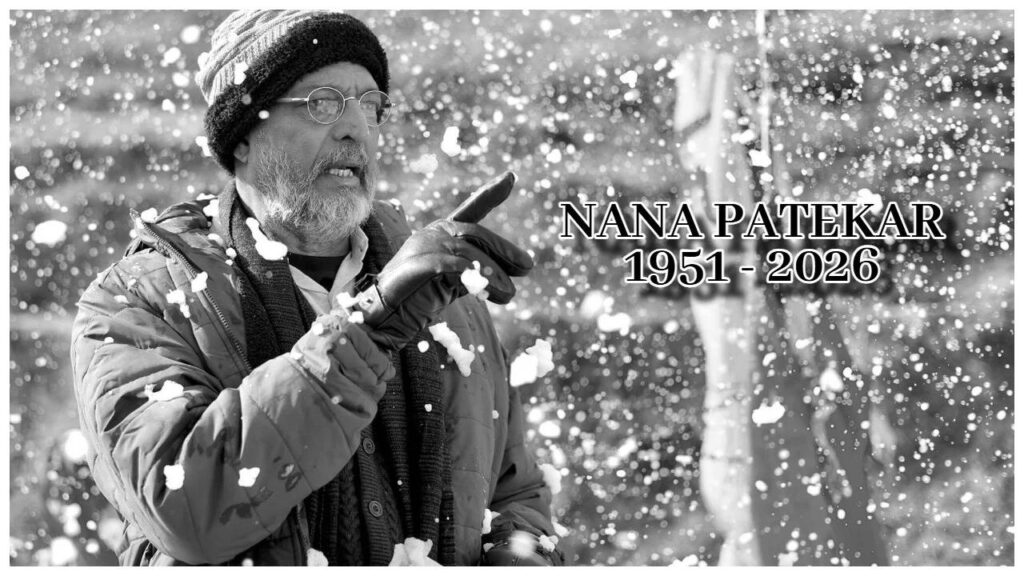

Nana Patekar, one of the most distinctive actors in Hindi and Marathi cinema, has died at the age of 75. The veteran actor was found unconscious at his residence in Dona Paula, Goa, early Thursday morning and was taken to Manipal Hospital, where doctors were unable to revive him. Hospital authorities said he had suffered a severe cardiac arrest. A medico-legal case has been registered and a post-mortem examination is being conducted. The Times of India reported the death, while Reuters independently confirmed the news and the hospital account.
Nana Patekar’s final hours in Goa
According to Manipal Hospital’s Dr Shekhar Salkar, Patekar was found unconscious at his Dona Paula home and brought to the hospital in the early hours of Thursday. Doctors attempted resuscitation for roughly 45 minutes, but he could not be revived. Later reports said his body was sent to Goa Medical College for post-mortem examination. These details remain part of the official medical and medico-legal process, rather than a completed forensic finding. citeturn0search2turn0search7
His son Malhar confirmed the death to The Indian Express and said his father died from natural causes. The actor had been in Goa only days earlier, attending the inauguration of a theatre club in Dona Paula. At that event, he spoke about the importance of theatre and the need for artists to keep trying new things. citeturn0search3
The Maharashtra government has announced that Patekar will receive a state funeral. His last rites are scheduled at his farmhouse in Donje near Pune, where his mortal remains are being taken for the final ceremonies. citeturn0search0turn0search6
A career that never depended on the conventional Bollywood hero
Born Vishwanath Patekar in Maharashtra in 1951, Nana Patekar came into acting through Marathi theatre before building a screen career that stretched across serious drama, crime films, social stories and mainstream comedy.
His film debut came with Gaman in 1978. From there, he developed a reputation for performances that could be restrained one moment and explosive the next. He did not fit neatly into the conventional leading-man mould. Villains, morally complicated characters, police officers, soldiers, troubled protagonists and comic figures all became part of his range.
That range became particularly visible through films including Parinda, Prahaar, Krantiveer, Agni Sakshi, Ab Tak Chhappan, Apaharan, Welcome and Natsamrat. His career also included work as a director and writer. citeturn1view0turn0search3
Three National Awards and a Padma Shri
Patekar’s recognition was not limited to popular cinema. He won the National Film Award three times. He received Best Supporting Actor for Parinda in 1989, Best Actor for Krantiveer in 1994 and Best Supporting Actor for Agni Sakshi in 1996.
In 2013, he was awarded the Padma Shri for his contribution to the arts. Those honours reflected a career in which commercial success and difficult, character-driven performances often existed side by side. citeturn1view0turn0search1
From theatre intensity to mainstream comedy
One reason Patekar remained so recognisable across generations was his ability to move between very different kinds of cinema without losing the intensity associated with his theatre background.
Krantiveer and Ab Tak Chhappan showcased the forceful dramatic persona that became closely associated with him. Natsamrat returned him to the emotional territory of theatre and ageing, while the Welcome films introduced a very different side of his screen personality to a mass audience.
That contrast was part of his appeal. Patekar could command a scene through silence, a sudden change in expression or a few sharply delivered words. He did not always need the conventional machinery of a star vehicle to become the centre of a scene.
His final years still included theatre and new screen work
Patekar continued working late into his career. His recent screen appearances included Housefull 5, O’Romeo and Subedaar, while he also appeared in Prakash Jha’s web series Sankalp earlier in 2026, according to The Indian Express. citeturn0search3
His final public appearance came only days before his death, when he attended the October 4 inauguration of Samraat Club International in Dona Paula. His comments there about theatre, creativity and the finite nature of life have taken on added significance following his death, although they were made as part of a broader discussion about the performing arts rather than as a statement about his own immediate health. citeturn0search3
Tributes arrive from across Indian cinema and public life
Tributes followed quickly after news of his death. Actor Akshay Kumar described Patekar as a performer with a rare combination of talent, intensity and authenticity. President Droupadi Murmu, Vice President C. P. Radhakrishnan and Prime Minister Narendra Modi also expressed condolences, highlighting his contribution to Hindi and Marathi cinema. citeturn0news10turn0search5
Maharashtra Chief Minister Devendra Fadnavis also paid tribute to Patekar, recalling the actor’s contribution to both Marathi and Hindi cinema. The decision to accord him a state funeral reflects the significance Maharashtra has attached to his work in Marathi theatre and film as well as his national career. citeturn0search3turn0news11
Why Nana Patekar’s legacy feels different
Patekar’s place in Indian cinema was never simply about the number of films he made or the awards he received. His legacy is tied to the kind of performer he was: an actor who could carry difficult material without making it feel distant, and who could move into popular entertainment without abandoning the sharpness of his performances.
His career also connected several worlds that are often treated separately: Marathi theatre, parallel and art-house cinema, mainstream Hindi films and contemporary streaming projects. For audiences who encountered him in different decades, there was usually a different Nana Patekar waiting in the next film.
That versatility is likely to be one of the defining parts of the tributes that follow. From Parinda and Krantiveer to Natsamrat and Welcome, his work crossed genres while retaining a recognisable screen presence.
Nana Patekar’s death closes the career of an actor whose influence was built less on conventional stardom than on the ability to make audiences stop and watch. At 75, he leaves behind a body of work that spans more than four decades and two major Indian film languages, as well as a lasting connection to theatre.

