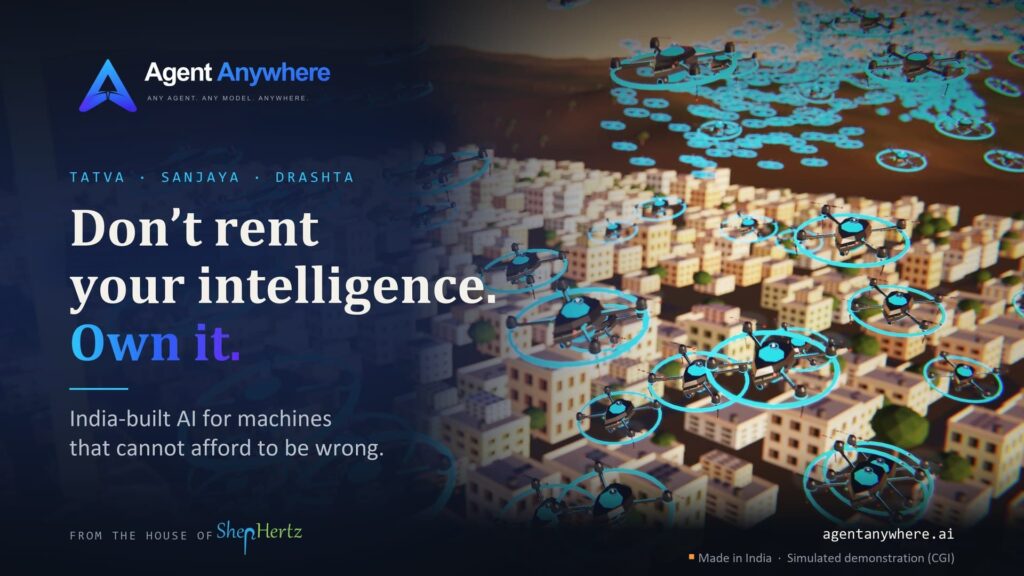

India’s push for sovereign AI is moving into a less glamorous but potentially more important corner of the market: machines that cannot depend on a cloud connection. ShepHertz has unveiled three AI model families, Tatva, Sanjaya and Drashta, designed to run directly on constrained hardware ranging from satellites and drones to industrial systems and even smart rings.
The models were unveiled at Drone Expo 2026 in New Delhi and form part of ShepHertz’s AgentAnywhere sovereign AI platform. Unlike the large cloud models that usually dominate AI headlines, these systems are being designed around a harder constraint: sometimes the device needs to make sense of data when there is no network available at all.
The interesting part is not the model count. It is where the models are expected to run.
ShepHertz’s pitch is built around an environment where latency, connectivity and hardware resources are all constrained. Its models are intended to operate locally, without sending every request to a remote data centre. That can matter in places where a machine is operating beyond reliable connectivity, where data cannot leave the site, or where a response needs to be produced without waiting for a round trip to a server.
That makes the announcement less about competing with general-purpose chatbots and more about building specialised intelligence for machines. The company describes the three families as complementary rather than interchangeable.
Tatva is built to turn language into one permitted action
Tatva is the most command-oriented of the three. ShepHertz says it can take a plain-language instruction in English, Hinglish or an Indian language and translate it into exactly one command that the connected machine already understands, or refuse to issue a command.
That “one command or refuse” design is important in high-consequence environments. A general conversational model is rewarded for producing useful text. An operational model has to be much more constrained because ambiguity itself can become a failure mode.
The company says Tatva is trained from scratch in India and that Tatva Edge is currently in private preview. It also makes a point of saying that Tatva is not a targeting or weapons-release system and is never placed in a weapons-release chain.
Sanjaya is aimed at the data machines generate, not the commands they receive
Sanjaya takes a different route. Instead of translating a human instruction, it watches telemetry from systems where an unusual reading may matter more than a natural-language request.
ShepHertz says Sanjaya is being developed for environments including spacecraft ground segments, electrical grids and industrial plants. Its job is to flag anomalies for an operator rather than make the final decision itself.
That distinction points to one of the more practical uses of small, local AI. A telemetry system can generate an enormous stream of measurements while operating far from a central analytics platform. Running the first layer of anomaly detection locally can reduce bandwidth requirements and allow a system to surface something unusual even when communications are intermittent.

Drashta brings machine vision closer to the sensor
Drashta is the computer-vision component of the lineup. ShepHertz says it is designed to identify aircraft and structures in satellite and aerial imagery while running offline and inside the operational perimeter.
The output is intended to be structured information handed to an analyst, rather than a fully autonomous decision. That is a recurring pattern across the three models: the AI observes or proposes, while a human remains responsible for consequential action.
The company is making a bigger bet on verifiable AI, too
The model launch is only half of the announcement. ShepHertz is also opening parts of its AI trust toolchain under the Apache 2.0 licence, starting with Shuddhi.
According to the company’s launch post, Shuddhi is a data factory that processes a training corpus and issues a signed, verifiable receipt describing its provenance. The company says additional components, including Model Hub, Agent Universal Gateway, Annotator and Nabhika OS, are expected to follow.
This is an important detail because the promise of sovereign AI is not only about where a model runs. For organisations working with sensitive information, being able to explain where training data came from, which model version was used and what an AI system actually did can be as important as raw benchmark performance.
There is a difference between offline AI and autonomous AI
It would be easy to read the defence angle and assume these systems are being positioned as autonomous battlefield software. The company’s own description is more restrained.
ShepHertz says the demonstrations shown at Drone Expo, including drone mission operations and a swarm handover, were simulated. It says the governance layer, approval process and signed receipts are real, but the demonstrations themselves should not be interpreted as evidence that the company has deployed autonomous weapons technology. citeturn249727view0
That distinction matters. Running AI locally can make a system more resilient and reduce dependence on the cloud, but it does not automatically make that system autonomous. In fact, one of the company’s core design claims is the opposite: rules outside the model determine what is allowed, and a named person approves consequential actions.
Why India’s hardware-first AI push could become strategically important
Cloud AI has made it possible to put enormous models behind almost any application, but that architecture assumes dependable communications and access to powerful remote infrastructure. Those assumptions break down in remote industrial sites, aircraft, satellites, drones, disconnected facilities and other edge environments.
Smaller specialised models offer a different trade-off. They can sacrifice some of the breadth of a general-purpose model in exchange for lower compute requirements, predictable behaviour and local operation.
That is particularly relevant to India’s broader interest in sovereign technology. ShepHertz describes AgentAnywhere as deployable on a customer’s infrastructure, inside its jurisdiction and under its own governance. The company’s wider platform materials also position the system for regulated sectors including government, banking and healthcare. citeturn411602search1turn411602search8
The difficult part will be proving that the small models hold up in the real world
The announcement is promising, but several questions will determine whether these models become important products rather than another set of AI demonstrations.
ShepHertz has disclosed that Tatva Edge is in private preview and says Sanjaya and Drashta are engaged with design partners. The next meaningful evidence will therefore come from deployments, independent evaluation and details about model size, latency, accuracy, power consumption and failure behaviour on the hardware where these systems are expected to run.
Those measurements are especially important for defence and space applications. A model that performs well in a data-centre environment can behave very differently when it has a fraction of the memory, compute and power available, or when its inputs are noisy and communications are intermittent.
From satellites to smart rings, the same idea is spreading
The broader idea behind Tatva, Sanjaya and Drashta is bigger than defence. ShepHertz explicitly describes a range that extends from satellites to smart rings, reflecting a growing shift toward AI that lives at the edge rather than exclusively in the cloud.
For India, the interesting question is whether companies can build an ecosystem around that idea: models that are small enough to run locally, infrastructure that keeps their actions auditable, and open tooling that makes the provenance of data and outputs easier to verify.
That would make this launch worth watching well beyond Drone Expo. The real test will not be another impressive demo. It will be whether these models can quietly do useful work in places where the network is unreliable, the hardware is limited and there is no room for an AI system to guess.
Further reading: ShepHertz’s launch announcement · AgentAnywhere · AgentAnywhere documentation · Shuddhi on GitHub · Our recent look at the security challenges around agentic AI